
Natural gemstones are admired for their beauty, rarity, and timeless appeal. From dazzling diamonds and deep blue sapphires to vivid rubies and lush green emeralds, every gemstone has its own characteristics that influence its desirability and value.
One of the most common questions asked by gemstone buyers is: “Why do two gemstones of the same type and similar size have such different prices?”
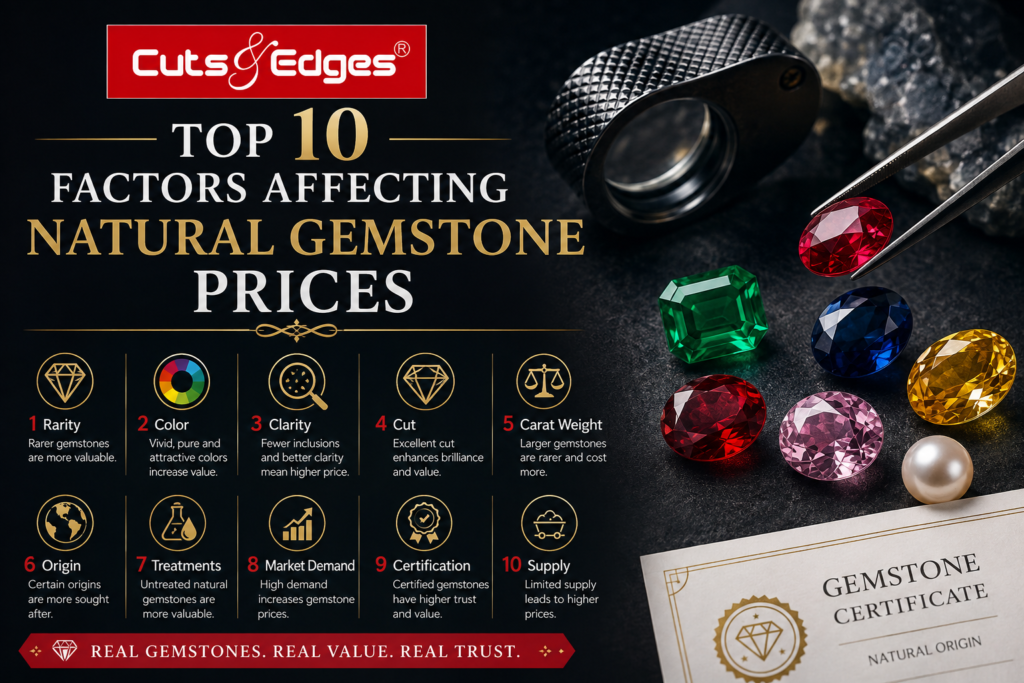
The answer is that natural gemstone prices are determined by multiple factors, not simply by weight or appearance. Colour, clarity, cut, rarity, treatment, origin, certification, demand, and even the availability of a particular gemstone can significantly influence its price .
Understanding these factors is essential before buying a gemstone for jewellery, investment purposes, collection, or traditional astrological use.
In this article, we discuss the top 10 factors affecting natural gemstone price and explain what buyers should consider before making a purchase.
1. Rarity
Rarity is one of the most important factors affecting the gemstone price of a natural gemstone.
Gemstones that are difficult to find in desirable quality and size are generally more valuable than commonly available stones. However, rarity alone does not automatically make a gemstone expensive. Demand and quality must also be considered.
For example, a gemstone may be relatively rare, but if its colour or clarity is undesirable, its market value may remain modest. Conversely, a rare gemstone with exceptional colour, clarity, and size may command a substantial premium.
The combination of rarity + quality + demand is what often creates exceptional value.
Some gemstones can also become rarer in the market when certain mining sources produce less material or when access to particular deposits becomes restricted.
2. Colour
Colour is a major factor when determining the value of many coloured gemstones.
A gemstone’s colour is usually evaluated in terms of hue, tone, and saturation.
Hue
Hue refers to the basic colour of a gemstone, such as red, blue, green, or yellow.
Tone
Tone describes how light or dark the colour appears.
Saturation
Saturation refers to the strength or intensity of the colour.
Clarity refers to the presence, size, type, location, and visibility of internal inclusions and surface characteristics.
Unlike diamonds, where high clarity is often strongly associated with higher value, coloured gemstones can be more complicated.
Many natural coloured gemstones contain inclusions because they formed naturally within the Earth. In some gemstone varieties, certain inclusions can even provide useful evidence during gemological identification.
However, excessive or highly visible inclusions can reduce transparency, brilliance, durability, and overall visual appeal.
The influence of clarity also differs greatly by gemstone type.
For example, clarity can play an especially important role in some transparent gemstones, while certain emeralds can naturally contain more inclusions without being considered undesirable.
Therefore, buyers should not assume that “flawless” always means “best.” The right clarity standard depends on the gemstone variety and market.
4. Carat Weight And Size
Size and weight are also important factors affecting natural gemstone price.
Gemstones are commonly priced based on carat weight, but the gemstone price does not necessarily increase at a fixed rate as weight increases.
A larger gemstone of excellent quality may be considerably more valuable than several smaller stones of the same variety.
In some gemstone categories, the price per carat can increase dramatically once a stone reaches a particular size threshold because large, high-quality specimens are much harder to find.
For example, a one-carat gemstone and a five-carat gemstone cannot always be compared using a simple five-times calculation.
The relationship between size and price depends on:
- Gemstone variety
- Colour quality
- Clarity
- Cut
- Treatment
- Rarity
- Market demand
Large stones with exceptional quality can command significant premiums.
5. Cut And Craftsmanship
Cutting is another important factor that influences gemstone price.
A well-cut gemstone can improve how light interacts with the stone, enhancing its brilliance, colour display, symmetry, and overall appearance.
The cutter must balance several considerations, including:
- Beauty
- Proportions
- Symmetry
- Light performance
- Weight retention
- Natural characteristics of the rough
A poorly cut gemstone may appear dull, overly deep, excessively shallow, or unbalanced, even if the rough material was valuable.
However, maximising weight is not always the goal. An experienced cutter may remove additional material to produce a more attractive finished gemstone.
For this reason, two stones of the same variety and weight can have noticeably different values.
6. Origin
Origin can influence the gemstone price of certain natural gemstones, particularly when a specific geographic source is associated with desirable characteristics or strong market recognition.
Some gemstone origins have developed reputations for producing material with particular colours, clarity characteristics, or other desirable features.
However, origin should not be treated as an automatic guarantee of quality.
A gemstone from a famous source is not necessarily better than every gemstone from another location. The actual quality of the individual stone remains extremely important.
Reliable origin determination can also require advanced laboratory analysis, and not every gemstone can be assigned a definitive geographic origin.
Therefore, buyers should be cautious of unsupported origin claims and should rely on credible gemological documentation when origin is an important part of the purchase.
7. Treatment
Treatment is a significant factor affecting gemstone price.
Many natural gemstones in the commercial market have undergone treatments designed to improve their colour, clarity, or appearance.
Common treatments may include:
- Heat treatment
- Fracture filling
- Dyeing
- Clarity enhancement
- Surface treatments
A treated gemstone can still be natural. Natural origin and treatment status are two different characteristics.
However, treatment can influence price because different treatments can have different levels of permanence, market acceptance, care requirements, and rarity.
Untreated natural gemstones that possess exceptional quality can be particularly desirable because such material may be much rarer.
Buyers should always ask:
Is the gemstone natural? Has it been treated? What treatment was used?
Treatment information should be clearly disclosed before purchase.
8. Certification And Laboratory Reports
Certification can significantly influence buyer confidence and, consequently, marketability.
A reputable laboratory report may provide information about gemstone identity, whether it is natural or synthetic, and evidence of certain treatments. Depending on the gemstone and laboratory, reports may also address other characteristics.
Certification is especially important for expensive gemstones because it provides independent documentation that can support the seller’s description.
However, buyers should remember that not all certificates carry the same level of authority.
Before purchasing, check:
- Name of the laboratory
- Report number
- Gemstone identification
- Natural or synthetic status
- Treatment information
- Weight and measurements
- Any stated origin information
A certificate does not replace careful evaluation, but an appropriate laboratory report can add significant transparency to the buying process.
9. Market Demand
Market demand can have a major effect on gemstone prices.
Like many luxury products, gemstones are influenced by consumer preferences, fashion, supply availability, cultural trends, and purchasing patterns.
When demand for a particular gemstone increases while supply remains limited, prices may rise.
Conversely, a gemstone may experience lower pricing when demand decreases or when substantial supply becomes available.
Demand can also vary between different markets and countries.
Some gemstones may be especially popular in one region because of jewellery trends or traditional preferences, while another market may place greater demand on different varieties.
This is why gemstone pricing is not completely static.
10. Supply And Availability
The final major factor is supply.
The availability of high-quality natural rough material can influence gemstone prices significantly.
Even when a gemstone variety itself is relatively common, high-quality material in desirable colours, sizes, clarity levels, and untreated condition may be difficult to obtain.
Mining conditions, production levels, geological deposits, regulations, transportation, and access to rough material can all affect supply.
When supply of exceptional-quality gemstones is limited, prices can increase, particularly when strong demand exists.
This explains why two gemstones of the same variety can have drastically different values.
Why Do Natural Gemstone Price Vary So Much?
One of the biggest misconceptions among first-time buyers is that there should be a standard fixed price for each gemstone.
In reality, there is no single universal price for every ruby, emerald, sapphire, or yellow sapphire.
Consider two emeralds that weigh three carats each. One may have attractive colour, good transparency, excellent cutting, minimal treatment, and desirable documentation. The other may have less attractive colour, more visible inclusions, extensive treatment, or weaker market appeal.
Despite having the same weight, their market values may be very different.
This is why professional gemstone evaluation is so important.
Natural Gemstone Price Vs Synthetic Gemstone Price
Buyers should also understand the difference between natural and synthetic gemstones.
A natural gemstone is formed naturally through geological processes.
A synthetic gemstone is manufactured by humans but generally has essentially the same chemical composition and crystal structure as its natural counterpart.
An imitation or simulant resembles another gemstone but has a different composition or structure.
These three categories can have very different market values.
For example, a natural ruby, synthetic ruby, and red glass imitation may look similar to an inexperienced buyer, but their material identity and value are fundamentally different.
How To Get The Best Value When Buying Natural Gemstones
Getting the best value does not necessarily mean buying the cheapest gemstone.
Instead, focus on obtaining the best combination of quality, authenticity, documentation, and gemstone price for your requirements.
Here are some useful buying tips:
Compare Similar Gemstones
Compare stones of the same variety, approximate size, and quality level before making a decision.
Ask About Treatment
Treatment can significantly influence both price and care requirements.
Request Certification
For valuable gemstones, ask for an appropriate laboratory report.
Examine Colour Carefully
Colour differences can create major price differences between gemstones.
Consider The Purpose
A gemstone intended for daily-wear jewellery may need different characteristics than one purchased primarily for a collection.
Buy From A Trusted Seller
An experienced gemstone dealer can provide valuable guidance and explain why one gemstone costs more than another.
Common Mistakes Buyers Make
Many gemstone buyers focus only on weight and price. This can lead to poor purchasing decisions.
Some common mistakes include:
Choosing the cheapest gemstone: A very low price may reflect differences in quality, treatment, authenticity, or disclosure.
Ignoring treatment: Treatment can affect value and care requirements.
Assuming all natural gemstones are expensive: Natural origin alone does not determine high value.
Buying without documentation: Valuable purchases should ideally have appropriate supporting documentation.
Believing origin guarantees quality: Geographic origin is only one factor; the actual quality of the gemstone remains critical.
Judging only by appearance: Professional identification may be necessary to distinguish natural, synthetic, and treated materials.
Why Choose Cuts & Edges For Natural Gemstones?
At Cuts & Edges, we believe gemstone buying should be based on transparency, knowledge, and trust.
Based in Pune and established in 2012, Cuts & Edges specialises in natural and certified gemstones for jewellery and traditional astrological purposes.
Our range includes gemstones such as ruby, emerald, sapphire, yellow sapphire, garnet, pearl, coral, cat’s eye, and other precious and semi-precious gemstones.
Our professional approach focuses on helping customers understand the characteristics of the gemstone they are considering, rather than simply focusing on price.
Whether you are purchasing a gemstone for a custom jewellery design, a special occasion, a personal collection, or a traditional astrological purpose, understanding its quality and characteristics is an important part of the buying process.
Conclusion
Understanding natural gemstone price is essential for anyone planning to purchase a valuable gemstone.
The price of a gemstone is influenced by a combination of factors rather than a single characteristic. Rarity, colour, clarity, carat weight, cut, origin, treatment, certification, market demand, and supply all play important roles.
The most important lesson is that two gemstones of the same variety and weight can have completely different prices because their quality and market characteristics may differ significantly.
A gemstone should not simply look beautiful—it should also offer clarity about what it is, what quality it possesses, how it has been treated, and why it is priced the way it is.
Looking for natural and certified gemstones in Pune? Explore Cuts & Edges for professionally selected gemstones and knowledgeable guidance for your next purchase.
If you want more information please contact us.