
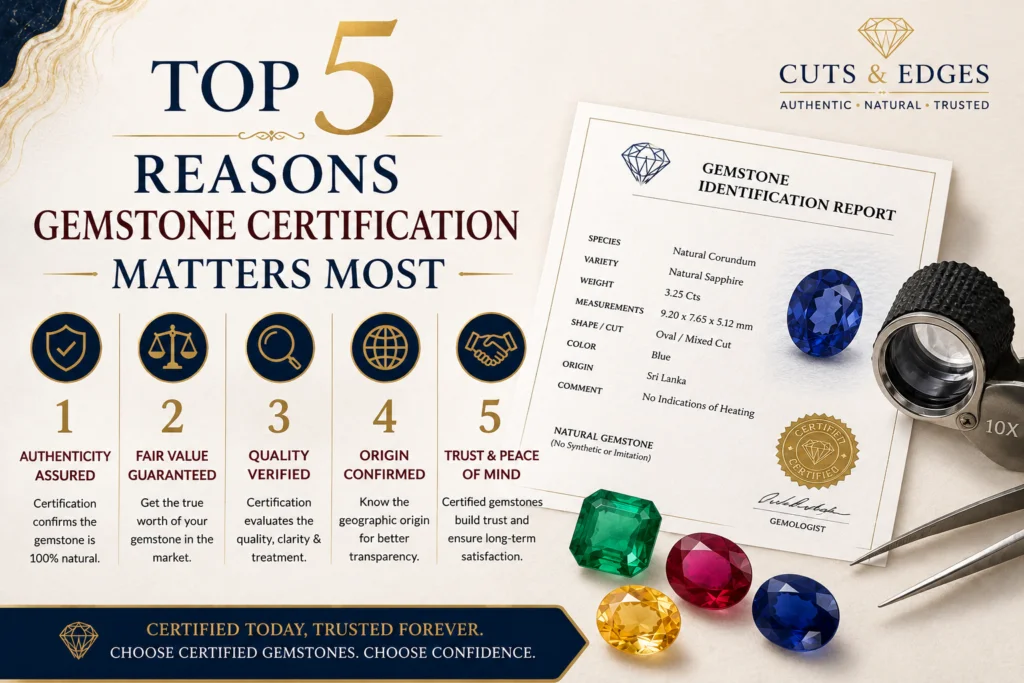
1. Certification Helps Establish Gemstone Identity
One of the most important reasons to consider gemstone certification is to understand what gemstone you are actually buying.
Gemstones can sometimes look similar despite having completely different identities, compositions, properties, and values.
For example, several blue stones may visually resemble sapphire to an untrained eye. However, visual appearance alone is not sufficient to establish gemstone identity.
A professional gemological examination can use specialised equipment and testing techniques to help identify the gemstone.
For buyers, this is particularly important when purchasing valuable stones such as:
- Ruby
- Emerald
- Sapphire
- Yellow Sapphire
- Diamond
- Alexandrite
- Spinel
- Tourmaline
- Aquamarine
A laboratory report can provide an additional level of confidence by documenting the laboratory’s findings about the gemstone.
However, buyers should always read the report carefully and understand exactly what has been tested and reported.
Why This Matters
The name of a gemstone can have a significant influence on how buyers perceive its value. Certification helps reduce uncertainty by providing documented gemological information rather than relying solely on appearance or verbal descriptions.
2. Gemstone Certification Helps Identify Natural Or Synthetic Stones
Another major reason gemstone certification matters is the distinction between natural and synthetic gemstones.
Natural gemstones form through natural geological or biological processes. Synthetic gemstones are laboratory-created materials that may have similar chemical and physical properties to their natural counterparts.
For some buyers, natural origin is an essential part of the value and appeal of a gemstone.
A professional laboratory can examine a gemstone for characteristics that help determine whether it is natural or synthetic.
For example, a report may identify a stone as:
Natural Ruby
or
Laboratory-Grown Synthetic Ruby
This distinction is extremely important when purchasing a higher-value gemstone.
It is also important to understand that an imitation is different from a synthetic gemstone. An imitation may simply resemble another gemstone without having the same chemical or crystal structure.
Natural Does Not Always Mean Untreated
Buyers should also remember that natural and untreated are not the same thing.
A natural gemstone may have undergone a treatment designed to improve its colour, clarity, or appearance.
Therefore, when buying an important gemstone, ask two separate questions:
Is the gemstone natural?
Has the gemstone been treated?
A suitable laboratory report can provide information about these characteristics when they are within the scope of the examination.
3. Gemstone Certification Can Provide Treatment Information
Gemstone treatments are an important part of the modern gemstone industry.
Certain treatments are commonly used to improve the appearance of gemstones. Depending on the gemstone, treatments can include processes such as heating, filling, irradiation, diffusion, or other enhancement methods.
Treatment is not automatically a sign that a gemstone is poor quality. Some treatments are widely accepted within the industry.
However, treatment disclosure is important because it can affect a buyer’s understanding of the gemstone and may influence its market value.
For example, a natural sapphire that has undergone heat treatment is different from a natural sapphire with no indications of heat treatment.
Similarly, certain treatments in emeralds are common and should be properly disclosed.
A gemstone certification report can help buyers understand whether a laboratory detected evidence of treatment.
Why Treatment Disclosure Matters
Without appropriate information, a buyer may find it difficult to compare two gemstones accurately.
Imagine two stones that look very similar:
- Gemstone A: Natural, with no indications of certain treatments
- Gemstone B: Natural, but with a detectable treatment
Their appearance may be attractive, but their characteristics and market considerations can be different.
Gemstone Certification and professional disclosure help buyers make a more informed comparison.
4. Gemstone Certification Supports Transparent Buying
Buying a gemstone should be an informed process.
A professional gemstone certification report can provide documented information that buyers can refer to when comparing stones, discussing pricing, or creating jewellery.
This is particularly useful when purchasing a high-value gemstone.
A transparent buying process should allow customers to ask questions such as:
- What type of gemstone is this?
- Is it natural or synthetic?
- Has it been treated?
- What is its weight?
- What are its measurements?
- What does the laboratory report state?
- Is the report from a recognised gemological laboratory?
- Does the report match the gemstone being offered?
These questions can help customers make purchasing decisions based on information rather than assumptions.
Gemstone Certification And Price
It is important to understand that a certificate does not automatically make a gemstone expensive or guarantee its value.
Gemstone prices depend on many factors, including:
- Colour
- Clarity
- Cut
- Carat weight
- Rarity
- Origin, where reliably established
- Treatment
- Demand
- Overall quality
Certification provides information that can help buyers understand these characteristics. It should be considered one part of the overall purchasing process.
5. Gemstone Certification Provides Greater Confidence For Valuable Purchases
The fifth major reason gemstone certification matters is confidence.
When purchasing an expensive gemstone, customers naturally want to reduce uncertainty.
A professional gemological report can provide documented information that helps buyers understand their purchase.
This can be especially useful for:
Jewellery Purchases
If you are purchasing a valuable gemstone for a ring, pendant, bracelet, or another piece of jewellery, certification can provide information about the centre stone before it is set.
Astrological Gemstones
Many people traditionally purchase gemstones for astrological purposes. In such cases, buyers may place particular importance on obtaining a natural gemstone with characteristics that meet their requirements.
While astrology is based on traditional beliefs rather than established scientific evidence, certification can still help verify the gemological characteristics of the stone being purchased.
Collectors
Gemstone collectors often care deeply about identity, quality, rarity, treatment, and origin information. Appropriate laboratory documentation can therefore be particularly valuable.
High-Value Gemstones
For expensive rubies, emeralds, sapphires, diamonds, and other important gemstones, independent documentation can add useful information to the purchase.
What Should You Check On A Gemstone Certification ?
Receiving a certificate is only useful if you understand what it says.
Before purchasing a certified gemstone, check the following information.
1. Laboratory Name
Identify which gemological laboratory issued the report.
2. Report Number
A unique report number should be present. Where available, buyers can use the laboratory’s official verification system to confirm the report.
3. Gemstone Identification
Check whether the report identifies the gemstone correctly.
4. Natural Or Synthetic Status
Look for information regarding whether the stone is natural or laboratory-created.
5. Treatment Information
Read the report carefully for statements about detectable treatments.
6. Weight And Measurements
Compare the gemstone’s physical measurements and weight with the information recorded on the report.
7. Photograph Or Identifying Features
Some reports include photographs or other identifying information. Compare these details with the actual gemstone where applicable.
Does Every Gemstone Need Gemstone Certification ?
Not necessarily.
Gemstone Certification can be particularly useful for higher-value gemstones, unusual stones, collector-quality specimens, and purchases where independent documentation is important.
For lower-value gemstones, the cost of certification may not always be practical.
The decision should depend on factors such as:
- Gemstone value
- Type of gemstone
- Intended purpose
- Buyer requirements
- Seller documentation
- Importance of treatment information
- Whether independent verification is desired
A reputable gemstone professional can help customers understand whether certification is appropriate for a particular purchase.
Gemstone Certification For Jewellery Manufacturing
Gemstone Certification can also be useful when selecting gemstones for custom jewellery.
At Cuts & Edges, customers can choose natural gemstones before creating jewellery around them.
For example, a customer may select a certified natural emerald and then create a custom gold ring based on its shape, measurements, and visual characteristics.
Similarly, a certified ruby can be selected for a traditional ring, while a sapphire can become the centre stone of an elegant pendant.
When combined with BIS-hallmarked gold jewellery, a carefully selected gemstone can become part of a professionally crafted piece designed for long-term use.
Why Choose Cuts & Edges For Natural Gemstones?
Cuts & Edges specialises in authentic natural diamonds and gemstones for customers looking for quality stones for jewellery and traditional astrological purposes.
Our approach is centred around helping customers understand the gemstone before purchasing it.
We offer a range of natural gemstones, including:
- Ruby
- Emerald
- Sapphire
- Yellow Sapphire
- Garnet
- Cat’s Eye
- Pearl
- Coral
- Diamond
- Other natural gemstones
We also manufacture fine jewellery using BIS-hallmarked gold, allowing customers to combine selected natural gemstones with professionally crafted jewellery.
For important gemstone purchases, we encourage customers to consider appropriate gemological documentation and understand exactly what a report confirms.
Our objective is simple: authenticity, transparency, quality, and customer confidence
If you want more information please contact us.