
Gemstones have always attracted attention because of their colour, brilliance, rarity, and timeless beauty. From ruby and emerald to sapphire, yellow sapphire, garnet, and other coloured stones, gemstones are used in jewellery, collections, and traditional astrological practices around the world.
However, today’s gemstone market offers both natural gemstone and synthetic gemstone, and understanding the difference between them is extremely important before making a purchase.
A synthetic gemstone can look remarkably similar to its natural counterpart. In many cases, even an inexperienced buyer may find it difficult to distinguish between the two simply by looking at them. Yet they can differ significantly in their origin, formation, internal characteristics, rarity, market value, and price.
So, what exactly is the difference between natural and synthetic gemstones?
In this guide, we explain the top 10 differences between natural and synthetic gemstones so that you can make a more informed purchasing decision.
What Is A Natural Gemstone?
A natural gemstone is a mineral or organic gem material that has formed naturally through geological or biological processes without being manufactured in a laboratory.
Natural gemstones may take thousands, millions, or even much longer periods to form, depending on their type and geological environment.
Examples include:
- Ruby
- Emerald
- Sapphire
- Yellow Sapphire
- Garnet
- Topaz
- Aquamarine
- Tourmaline
- Pearl
Natural gemstones can have unique inclusions, colour patterns, growth characteristics, and other internal features created during their formation.
What Is A Synthetic Gemstone?
A synthetic gemstone is a laboratory-grown material that has essentially the same chemical composition and crystal structure as its natural counterpart.
For example, laboratory-grown synthetic ruby is chemically and structurally related to natural ruby, but it is created under controlled laboratory conditions rather than forming naturally inside the Earth.
This distinction is important:
Synthetic does not mean fake.
A synthetic gemstone is a man-made version of a naturally occurring gemstone material. However, it should be accurately disclosed as synthetic because its origin and market value are different from those of a natural gemstone.
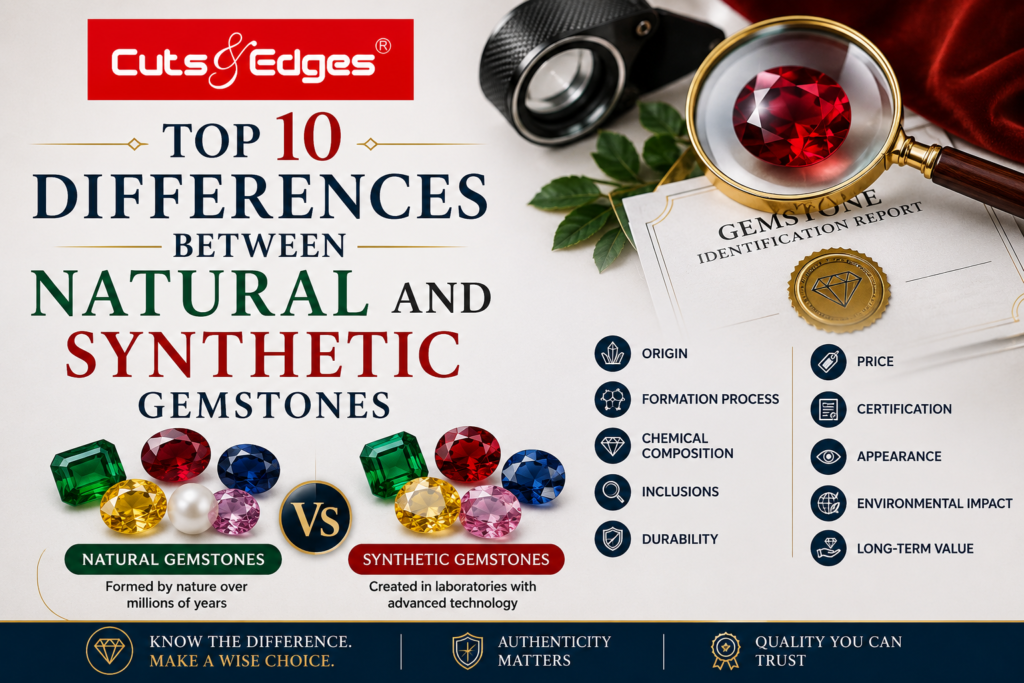
Top 10 Differences Between Natural And Synthetic Gemstone
1. Origin And Formation
The most fundamental difference is their origin.
Natural gemstone
Natural gemstones are formed naturally through geological processes. Heat, pressure, minerals, fluids, crystallisation, and geological activity can contribute to their formation.
Their development can take extraordinarily long periods.
Synthetic gemston
Synthetic gemstones are created by humans in controlled laboratory environments. Advanced technology is used to reproduce many of the conditions required for crystal growth.
Because the process is controlled, manufacturers can often produce gemstone material in significantly less time than nature requires.
Key difference: Natural gemstone are formed by nature, while synthetic gemstone are grown by humans.
2. Formation Time
The time required for formation is another major difference.
Natural gemstones can take extremely long periods to develop. Their formation depends on geological conditions that cannot simply be reproduced at will.
Synthetic gemstones, on the other hand, can be produced within a controlled manufacturing environment. Depending on the material and growth method, laboratory production may take significantly less time than geological formation.
This difference contributes to the rarity of natural gemstones.
A high-quality natural gemstone of substantial size may be difficult to find, while laboratory production can provide greater consistency and availability for certain synthetic materials.
3. Internal Inclusions And Growth Features
One of the most interesting differences can be found inside the gemstone.
Natural gemstones often contain inclusions and growth features created by their geological environment. These may include tiny crystals, fluid inclusions, needles, growth patterns, fractures, and other internal characteristics.
Synthetic gemstones can also contain inclusions, but their internal features often reflect their laboratory growth environment.
Gemologists examine these characteristics carefully when identifying gemstones.
Importantly, the presence of inclusions does not automatically prove that a gemstone is natural. Likewise, a visually clean gemstone is not automatically synthetic.
Professional gemological testing may be required for reliable identification.
4. Appearance
At first glance, natural and synthetic gemstones can sometimes look extremely similar.
A well-made synthetic ruby may have an appearance that is difficult for an ordinary buyer to distinguish from a natural ruby. The same principle applies to several other gemstones.
Both can display:
- Attractive colour
- Transparency
- Brilliance
- Faceted surfaces
- Excellent polish
This is why relying only on visual inspection can be risky.
For valuable gemstones, professional examination and laboratory documentation can provide considerably more confidence than appearance alone.
5. Rarity And Availability
Rarity is one of the biggest advantages associated with exceptional natural gemstones.
Nature produces gemstones under very specific geological conditions. High-quality material may be difficult to find, particularly in larger sizes or with highly desirable colour and clarity characteristics.
Synthetic gemstones can generally be produced in controlled quantities according to manufacturing capabilities.
This means that the market availability of certain synthetic gemstone materials can be considerably greater than comparable natural stones.
For collectors and buyers who value geological origin and natural rarity, this distinction can be extremely important.
6. Price
One of the most noticeable differences is price.
Natural gemstones can command higher prices because of their combination of natural origin, rarity, quality, size, colour, clarity, treatment status, origin, and market demand.
Synthetic gemstones are often more affordable because laboratory production can provide greater availability and reduce some of the scarcity associated with natural material.
However, there is no simple rule that every natural gemstone is expensive or every synthetic gemstone is inexpensive. Pricing depends on the specific gemstone, quality, size, production method, market demand, and other factors.
The right comparison is therefore:
Natural vs synthetic + comparable quality + appropriate disclosure + market conditions.
7. Market Value And Collectability
Natural and synthetic gemstones can have very different market positions.
Exceptional natural gemstones can appeal to collectors because of their geological origin, rarity, provenance, and scarcity.
Synthetic gemstones may be valued more for their appearance, accessibility, and affordability rather than natural rarity.
This does not mean that one is universally “better.” The better choice depends on the buyer’s purpose.
Someone looking for an affordable gemstone for jewellery may prefer synthetic material.
Someone looking for natural rarity and geological character may specifically seek a natural gemstone.
Understanding your purpose before purchasing can make the decision much easier.
8. Certification And Disclosure
Certification is particularly important when purchasing expensive gemstones.
A suitable laboratory report can provide information about whether a gemstone is natural or synthetic and whether certain treatments have been detected.
This is important because natural and synthetic stones can sometimes look similar to the untrained eye.
Buyers should look for documentation that clearly identifies:
- Gemstone variety
- Natural or synthetic status
- Weight
- Measurements
- Treatment information, where applicable
- Origin information, where reliably determined
The reputation and methodology of the laboratory also matter.
A seller should clearly disclose whether a gemstone is natural, synthetic, treated, or an imitation.
Transparent disclosure allows buyers to compare products fairly and understand what they are paying for.
9. Treatment And Enhancement
Both natural and synthetic gemstones may be subject to treatments or enhancements, depending on the material and manufacturing process.
Natural gemstones can be treated to improve colour or clarity. Common treatments in the industry include heating, filling, dyeing, and other enhancement processes.
Synthetic gemstones may also undergo post-growth treatments or processing.
This means that the terms natural and untreated are not interchangeable.
A natural gemstone can be treated.
A synthetic gemstone can also be treated.
Therefore, buyers should ask two separate questions:
Is the gemstone natural or synthetic?
and
Has it been treated or enhanced?
Understanding both answers is important when evaluating price and value.
10. Long-Term Perception And Buyer Preference
The final major difference is how buyers perceive and use each type.
Natural gemstones are often chosen because buyers appreciate:
- Natural geological origin
- Rarity
- Uniqueness
- Collectability
- Traditional significance
- Long-term sentimental value
Synthetic gemstones are often chosen because buyers value:
- Affordable pricing
- Attractive appearance
- Consistent availability
- Controlled production
- Accessibility
For jewellery, either option can be suitable depending on the design, budget, and personal preference.
The most important point is that the buyer should know exactly which type they are purchasing.
Natural Vs Synthetic Gemstones: Quick Comparison
| Feature | Natural Gemstones | Synthetic Gemstones |
|---|---|---|
| Origin | Formed naturally | Created in a laboratory |
| Formation | Geological or biological processes | Controlled manufacturing process |
| Rarity | Can be naturally scarce | Often more readily available |
| Inclusions | Natural growth features may occur | Laboratory growth features may occur |
| Appearance | Naturally developed | Can closely resemble natural material |
| Price | Can command higher prices | Often more affordable |
| Collectability | Often preferred for natural rarity | Usually valued for accessibility |
| Certification | Recommended for valuable stones | Important for accurate disclosure |
| Treatment | May be treated | May also be treated |
| Market Position | Natural rarity and origin | Affordability and consistency |
Are Synthetic Gemstones Fake?
No.
This is an important misconception.
A synthetic gemstone is not necessarily an imitation. It is a laboratory-created material that has essentially the same chemical composition and crystal structure as its natural counterpart.
For example, synthetic corundum used as synthetic ruby or sapphire is not simply glass painted to look like ruby or sapphire.
However, it must be correctly identified and sold as synthetic.
Synthetic vs Imitation
An imitation or simulant is a different material that only resembles the gemstone.
Examples might include:
- Glass resembling ruby
- Cubic zirconia resembling diamond
- Synthetic spinel used to imitate certain gemstones
Synthetic and imitation therefore mean different things.
Why Professional Gemstone Testing Matters
It can be difficult for an ordinary buyer to distinguish natural and synthetic gemstones by sight alone.
Modern laboratory-grown gemstones can have impressive colour, transparency, and visual similarity to natural material.
A professional gemologist may use microscopic examination, spectroscopy, fluorescence testing, specific gravity, refractive measurements, and other advanced techniques depending on the gemstone.
For valuable purchases, an independent laboratory report can provide additional confidence.
This is particularly important when a seller claims that a gemstone is rare, untreated, or from a prestigious origin.
Which Should You Buy: Natural Or Synthetic?
There is no universal answer.
The right choice depends on your priorities.
Choose a natural gemstone when you value:
Natural origin: You want a stone formed naturally within the Earth.
Rarity: You appreciate scarcity and geological uniqueness.
Collectability: You are interested in natural specimens and their long-term significance.
Traditional preferences: You specifically require a natural gemstone for a traditional astrological purpose.
Choose a synthetic gemstone when you value:
Affordability: You want the appearance and material characteristics of a gemstone at a lower price point.
Availability: You want consistent access to particular colours and sizes.
Budget flexibility: You want to allocate more of your jewellery budget to the design or setting.
Neither choice is automatically right for everyone. The key is making an informed decision.
How To Buy Authentic Natural Gemstones
If your preference is specifically for natural gemstones, consider the following steps before purchasing:
Buy From A Reputable Seller
Choose an established gemstone dealer with professional knowledge and transparent business practices.
Ask Whether The Stone Is Natural
Do not assume that a gemstone is natural because it looks genuine.
Request Appropriate Certification
For valuable gemstones, ask for a suitable laboratory report.
Ask About Treatments
Understand whether the gemstone has been heated, filled, dyed, or otherwise enhanced.
Compare Quality
Look at colour, clarity, cut, transparency, size, and overall appearance.
Obtain An Invoice
Proper purchase documentation helps establish what was sold and at what price.
Why Choose Cuts & Edges?
At Cuts & Edges, we believe gemstone buying should be transparent, informed, and professional.
Based in Pune and established in 2012, Cuts & Edges specialises in natural and certified gemstones for jewellery and traditional astrological purposes.
Our range includes ruby, emerald, sapphire, yellow sapphire, garnet, pearl, cat’s eye, coral, and other precious and semi-precious gemstones.
Our professional approach focuses on helping customers understand the gemstone they are purchasing, including its characteristics, quality, treatment information, and certification where applicable.
Whether you are searching for a gemstone for a custom jewellery design, special occasion, collection, or traditional astrological purpose, choosing the right source is an important part of the buying process.
Conclusion
Understanding the difference between natural and synthetic gemstones is essential for making a confident purchase.
Natural gemstones are formed naturally and can offer rarity, geological uniqueness, and strong appeal to collectors and traditional buyers. Synthetic gemstones are laboratory-grown and can provide attractive alternatives with greater availability and often lower prices.
The key differences include origin, formation time, internal characteristics, appearance, rarity, price, market value, certification, treatment, and buyer preference.
Most importantly, synthetic does not automatically mean fake, and natural does not automatically mean superior in every situation. The right gemstone depends on your purpose, preferences, budget, and expectations.
Before buying, always ask questions, verify the gemstone’s identity, understand any treatments, check documentation, and purchase from a trusted gemstone professional.
When you know the difference, you can choose with confidence.
Looking for authentic natural gemstones in Pune? Explore Cuts & Edges for natural and certified gemstones backed by professional gemstone knowledge and trusted guidance.
If you want further information please contact us.